E-bus Procurement Observatory (LAC)
Select a city:
Mexico City, MX
City context
Mexico City is one of the largest and most populous urban areas in Latin America, and operates a complex public transport system at both the municipal and metropolitan levels. Alongside an extensive subway system, bus-based transport plays a central role in the region’s mobility system, particularly through the Metrobús BRT network, which has become an important entry point for the implementation of electric buses. Currently, Mexico City has over 800 electric buses throughout its multiple transport services, according to the E-Bus Radar (Feb 2026), the majority of which are trolleybuses.
Public transport governance and business models in Mexico are highly heterogeneous, and Mexico City reflects this diversity. The system combines public coordination with predominantly private operation, which is the case of Metrobús, while also including public operators such as Red de Transporte de Pasajeros (RTP) and the trolleybuses operated by Servicios de Transportes Eléctricos (STE). This results in multiple procurement, financing, and ownership arrangements within the region.
The review of procurement documents in Mexico City resulted in three documents, all related to fleet purchases and corresponding to 2024 and 2025. Together, these procurements account for the purchase of 60 battery-electric buses and 19 trolleybuses. It is important to note that the procurement documents identified in Mexico City refer exclusively to contracts involving public operators (RTP and STE) and therefore do not capture electric fleet acquisitions by private operating companies.
Governance, Business, and Financial Model
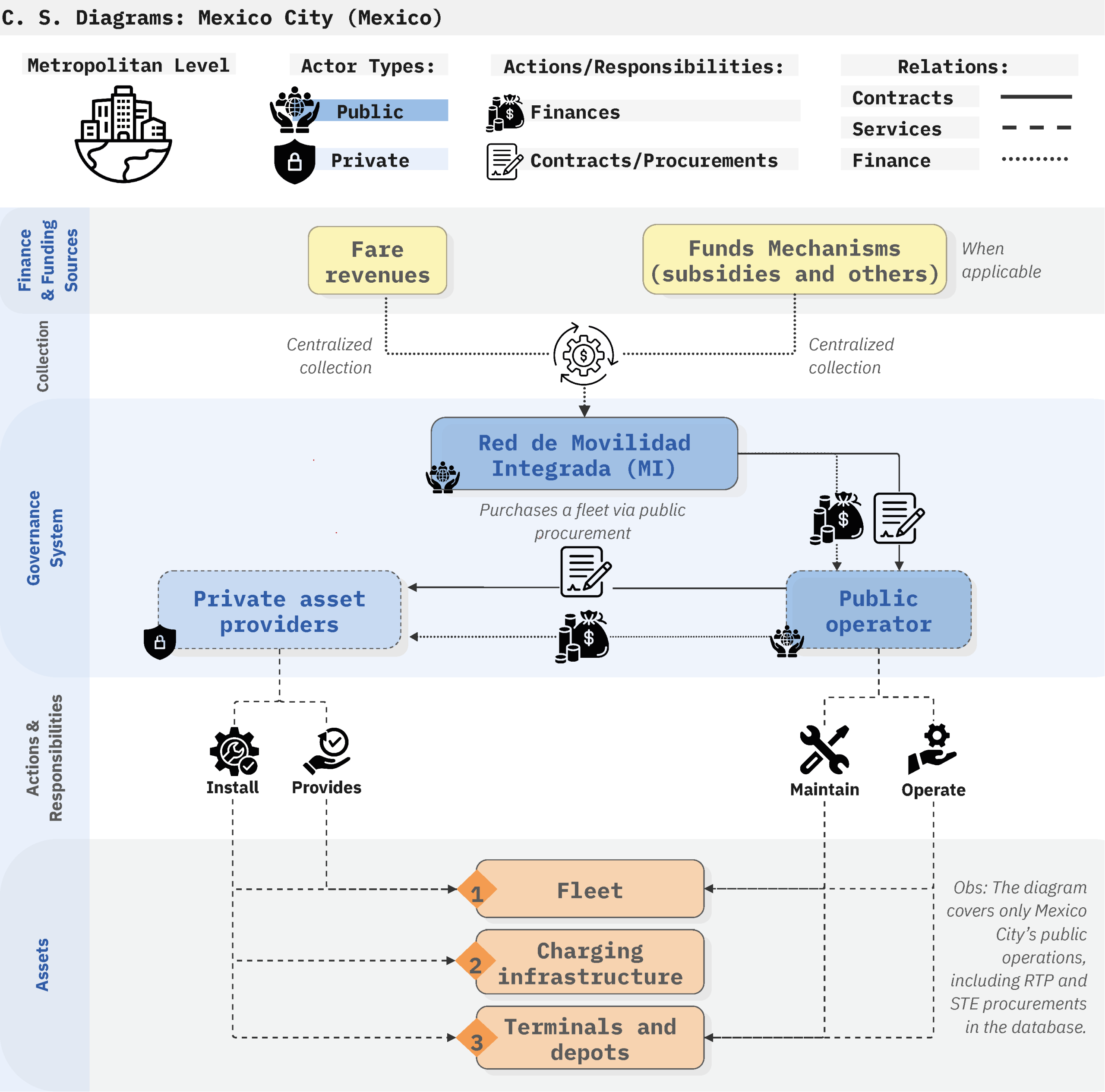
The Mexico City case is characterized by a mixed public-private model, in which operational responsibility, fleet provision, and financial management are distributed across different actors. It is worth noting, however, that only public procurement processes were included in the database, due to the availability of documentation.
Public operators, such as RTP and STE, are responsible for conducting procurement processes for fleet acquisition, including electric buses, and these are the documents identified in the database. Parallel to these models, the BRT system coordinated by Metrobús, does not own the fleet nor directly procure vehicles. Instead, it contracts transport services from operating companies, both public and private. Fleet provision follows different pathways depending on the operator.
In the Metrobús model, private operating companies, which account for the majority of operations, may acquire electric buses directly, through purchase or leasing arrangements, without passing through formal procurement procedures. In these cases, supporting documents were not publicly available for inclusion in the database. However, it is important to reinforce the system’s mixed public-private operational structure in Mexico City.
Financial management is centralized and organized through a private trust fund (fideicomiso) that manages financial assets on behalf of the system. Metrobús transfers financial resources to operating companies rather than purchasing
vehicles directly. At the same time, the fund can be adopted to finance certain investments, such as charging infrastructure, thus playing a central role in making electric bus deployment financially viable for both private and public
companies.
Another relevant feature of the Mexico City case is the limited number of electric bus manufacturers currently active in the local market. This reduces competition and constrains operators’ and authorities’ ability to compare technologies, prices, and technical characteristics across a broader set of suppliers.
Key takeaways
The Mexico City case illustrates how large-scale bus electrification can advance within a hybrid institutional structure that combines public coordination with public and private operations. This combination of operators, alongside multiple procurement and financing pathways, enables flexibility but also results in a fragmented landscape in which electrification progresses through different contractual arrangements rather than a single standardized model. For instance, this case contrasts with the system presented in Santiago, where operational and procurement models are standardized and follow a single, consistent procedure. While this does not imply an advantage for either case, it is important to highlight these existing differences.
More broadly, the experience of Mexico City highlights that electrification depends not only on vehicle technology but also on governance capacity, financial structuring, and the ability to coordinate multiple actors with distinct roles and responsibilities. These insights are particularly relevant for large metropolitan areas with mixed public-private transport systems that seek to scale up electrification beyond pilot projects.
In addition to these considerations, this case also highlights important structural constraints that should be accounted for when implementing electric bus projects. Limited market competition among manufacturers and uncertainties related to the national electricity system can affect the pace and scalability of bus electrification. In this context, vehicle electrification requires a robust (and ideally renewable-based) electricity matrix to ensure that its advantages are effectively achieved. These challenges reinforce the need for careful coordination between transport planning, the energy sector, and market regulation, particularly in systems with heterogeneous business models and multiple operating arrangements.
In the Mexican context, these difficulties are intensified by the strong dependence of cities and states on federal government resources, which makes it harder to mobilize local funding and sustain long-term electrification strategies. Taken together, these factors show that bus electrification is not only a technological transition, but also an institutional and financial one, requiring integrated governance and stable multilevel support to advance effectively.
References
This case study was developed based on the review and interpretation of publicly available procurement documents (id: 601, 602, and 603), as presented in the database, combined with discussions with representatives of one public transport entity (Metrobús). The analysis also draws on the review of relevant technical reports, as outlined in the project documentation.