E-bus Procurement Observatory (LAC)
Select a city:
Santiago, CL
City context
Santiago, the capital city of Chile, is a large metropolitan area home to almost 7 million people. The region is characterized as the leading public transport system for bus electrification in Latin America and the Caribbean (LAC), with a current fleet of over 2.5 thousand electric buses, according to the E-Bus Radar (Feb 2026). The city has undergone a long institutional transformation over the past decades, moving from a fragmented bus system to a centralized, highly regulated model coordinated by the Metropolitan Public Transport Directorate (in Spanish, Dirección de Transporte Público Metropolitano, DTPM). This institutional arrangement is a key contextual factor for understanding its large-scale transition to electric buses. Beyond the metropolitan level, electrification in Santiago is also linked to Chile’s national energy and climate policies, particularly those aimed at achieving zero-emission public transport nationwide. This long-term approach has local-level implications, facilitating coordination among authorities in planning strategies and investments in the sector.
The review of procurement documents in Santiago resulted in four documents being included in the database: three related to service operations (2019, 2023, and 2025) and one related to fleet provision (2019). In total, these documents account for the procurement of 2,030 vehicles under the fleet provision contract, of which approximately 3-4% must be electric. In addition, the operation procurements include provisions for the potential acquisition of additional electric buses, to be defined by bidders during the tendering process.
Governance, Business, and Financial Model
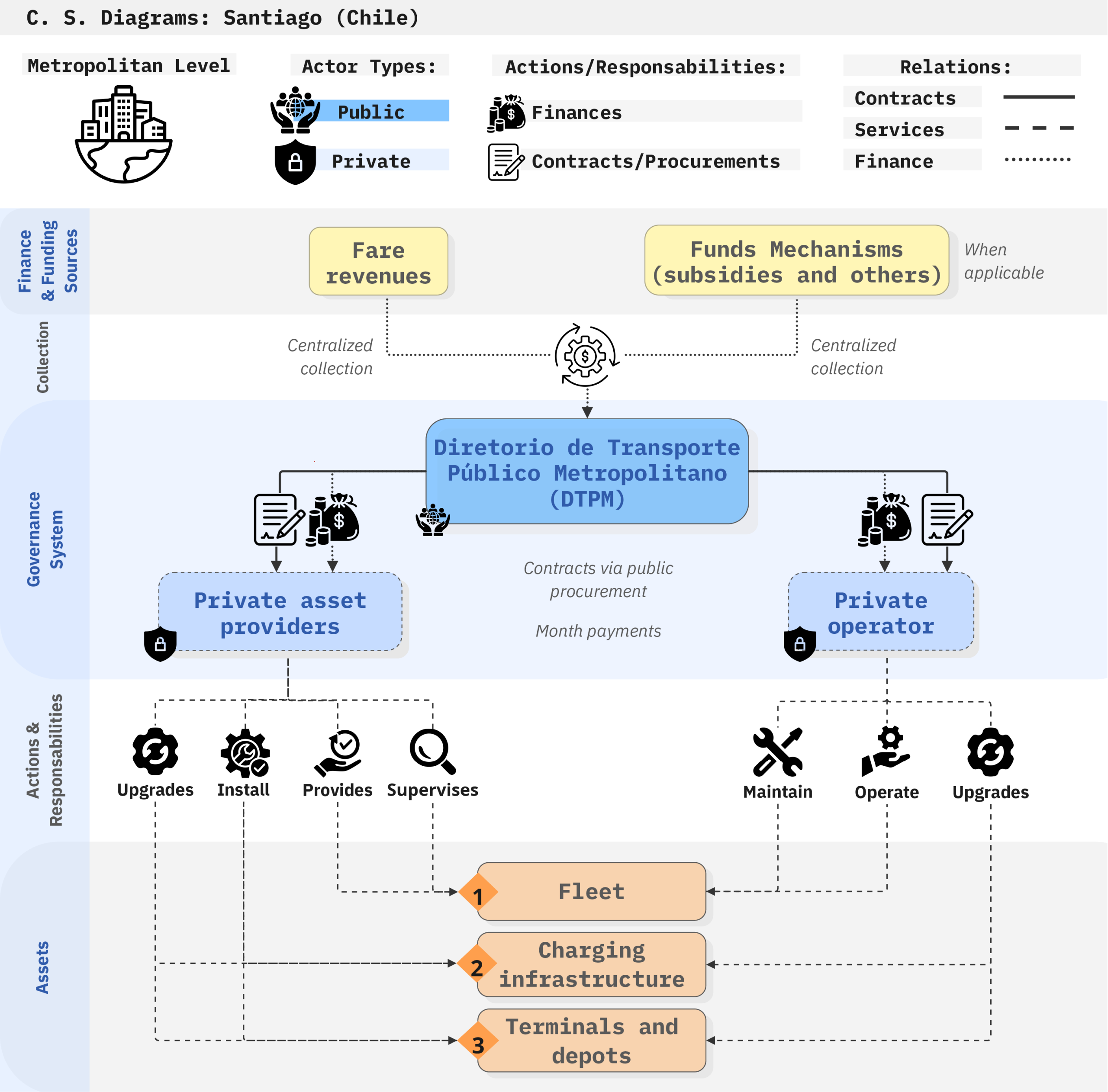
The Santiago case represents a dual-private-actor model managed within a centralized public system. Under this arrangement, two (or more) private entities share different responsibilities: one private company provides and finances the electric-bus fleet, while another is responsible for operating the services. DTPM plays a central coordinating role by conducting procurement processes, defining technical specifications, and managing subsidies and payment flows. While legal responsibility for service provision lies with the operators, the public authority actively structures the market to distribute risks among companies and ensure the long-term viability of the system.
Public subsidy is a fundamental element of this model. Subsidies are made available to both fleet providers and operators through a system of monthly payments. For instance, operators receive installments (the so-called quotas) through multiple mechanisms, including payments per passenger transported, per kilometer traveled, and, when necessary, additional resources for improvements in bus depots, charging infrastructure, or the acquisition of new electric buses. This structure provides long-term financial certainty, enables budget planning over extended time horizons, and supports a stable investment environment, making the activity more attractive and improving service quality.
Within this model, risk management is a particularly relevant feature. By centralizing payments and subsidies, the system reduces financial exposure for private companies, lowers costs, supports the rapid deployment of electric buses, and distributes risks across different actors.
Another relevant factor in Santiago’s success is Chile’s open-market policy, which allows competition among bus manufacturers. This competitive environment contributes to lower costs and greater affordability of electric buses compared to other Latin American markets.
Finally, the availability of publicly-provided depots plays a critical role in lowering barriers to market entry. If operators were required to independently acquire depots, participation would be limited to companies with access to strategically located facilities. By providing public depots, the system promotes competition, as reflected in high participation levels in recent procurement processes. In addition, depot upgrades can be incorporated into the model: when operators identify the need for improvements, such as additional space or charging capacity, these investments can be requested during the bidding process and are financed by the system through monthly payments.
Key takeaways
The Santiago case illustrates that large-scale bus electrification involves more than technological advances alone; it is also shaped by strong institutional arrangements. The separation of responsibilities between fleet provision, service operation, and public coordination allows risks to be allocated across different actors, while centralized planning and payment mechanisms provide stability and predictability for companies. In this context, electrification is enabled not by isolated technological choices but by a governance structure capable of coordinating contracts, subsidies, and long-term investments, as well as by consolidated national-level policies that make local implementation more feasible.
More broadly, Santiago’s experience highlights that successful electrification requires a strong regulatory environment and a public role in structuring the market. Public subsidies, centralized payment flows, access to public depots, and competitive procurement processes together create conditions that reduce financial uncertainty and increase attractiveness. These elements suggest that cities seeking to move beyond pilot projects must focus not only on vehicle technology but also on institutional capacity and coherent financial and contractual arrangements. However, such arrangements can be more challenging to implement in small- and mid-sized cities with limited institutional capacity, where simpler models may be more appropriate. Overall, the Santiago case represents a strong reference for best practices in the adoption of electric buses in public transport.
References
This case study was developed based on the review and interpretation of publicly available procurement documents, as presented in the database (id: 201, 202, 203, and 204), combined with discussions with representatives of the local authority (DTPM). The analysis also draws on the review of relevant technical reports, as outlined in the project documentation.
Procurements
- 201 – Concession of the use of road networks of service units nos. 20, 21 and 22, for the provision of urban paid public passenger transport services by bus, and authorization to call a public tender
- 202 – Concession of the use of road networks of service units nos. 14, 15, 16, 17 and 18, for the provision of urban paid public passenger transport services by bus, and authorization to call a public tender
- 203 – Concession of the use of road networks of service units nos. 1, 2, 3, 4, 5 and 6, for the provision of urban paid public passenger transport services by bus, and authorization to call a public tender
- 204 – Public Tender for the Complementary Bus Supply Service for the Public Transport System of the province of Santiago and the municipalities of San Bernardo and Puente Alto