E-bus Procurement Observatory (LAC)
Select a city:
São José dos Campos, BR
City context
São José dos Campos is a mid-sized city of almost 700 thousand inhabitants located in the state of São Paulo. Public transport services are organized at the municipal level, and compared with large metropolitan systems, the city operates a smaller, less complex bus network. This has allowed the city to test alternative fleet technologies, including electric buses, positioning São José dos Campos as a relevant example among mid-sized Brazilian cities for public transport electrification. According to the E-Bus Radar (Feb 2026), 24 electric buses are currently in operation in the city, with plans to significantly expand the fleet through additional procurement.
Electrification in São José dos Campos has been developed as part of broader efforts to modernize public transport and reduce local emissions. The city is an example of how medium-sized municipalities can incorporate electric buses into their transportation systems through more targeted arrangements rather than large-scale solutions.
The review of procurement documents in São José dos Campos identified one fleet leasing procurement process for 2024, involving the lease of 400 electric vehicles.
Governance, Business, and Financial Model
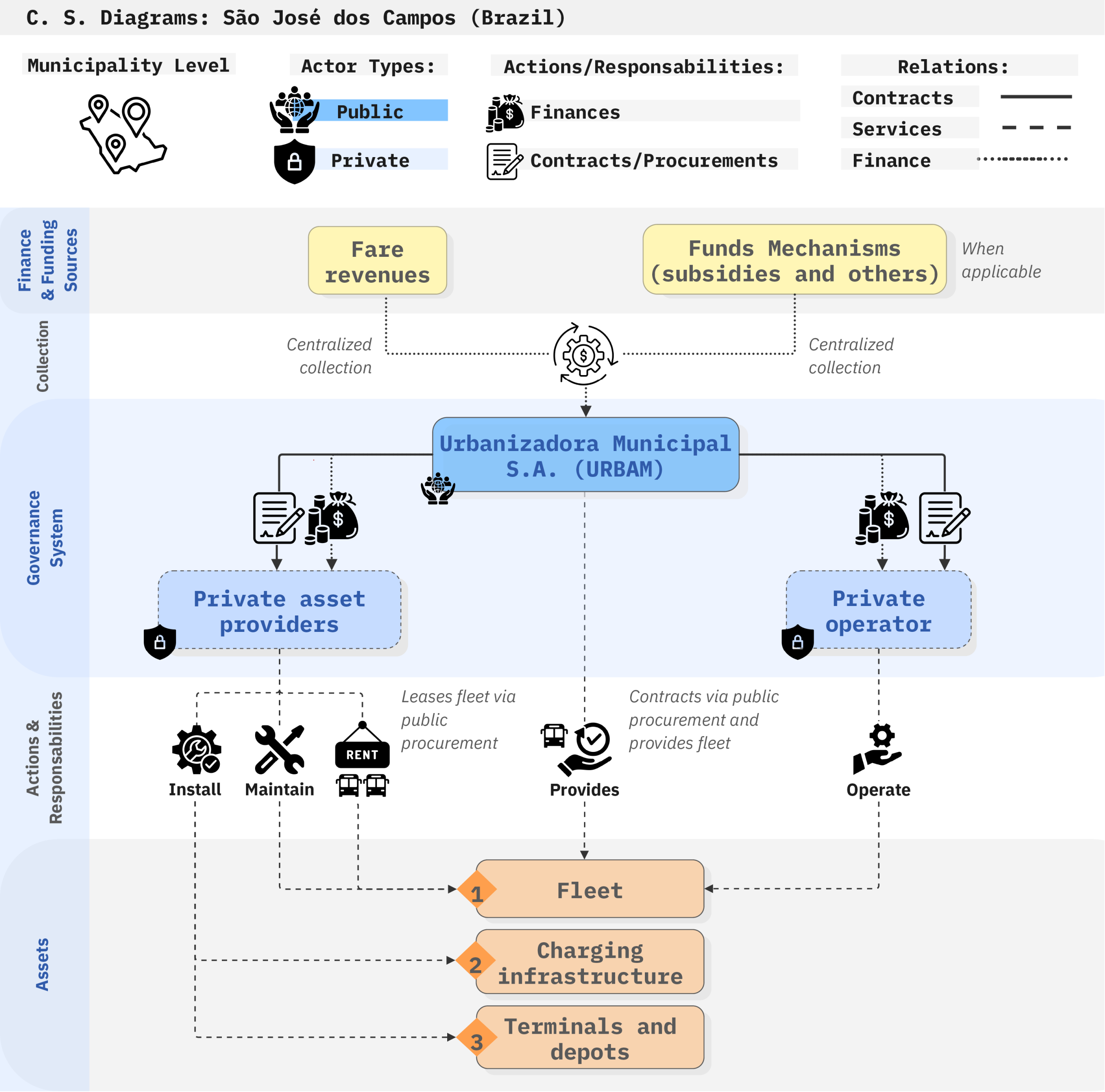
The São José dos Campos case is characterized by a public-ownership and private-operation model, in which the municipality plays a direct role in the provision of the fleet. Electric buses are leased through public-sector procurement processes, while service operations are carried out by private companies under concession contracts.
An important characteristic of this model is the use of fleet leasing arrangements, in which the public authority procures vehicles and makes them available to operators. For the public sector, this can lower upfront costs by allowing municipalities to lease vehicles through monthly payments rather than purchasing them outright. At the same time, the arrangement reduces investment needs and financial risks for private operators, while enabling the municipality to maintain control over fleet specifications, including technology. As a result, risks associated with vehicle acquisition are mostly taken by the public sector, making the transition to electric buses more attractive for service operators.
Another important characteristic of this model is the centralization of financial flows, in which the public sector is responsible for receiving fares and subsidies and transferring these resources to operators and fleet lessors in accordance with existing contracts. Combined with strong technical capacity, this arrangement positions the city to focus directly on system improvements, such as upgrades to charging infrastructure, bus corridors, terminals, and depots.
Key takeaways
This case illustrates how the implementation of electric buses on public transportation can be structured through more effective institutional arrangements, even in medium-sized cities with less than one million inhabitants. By separating fleet provision from service operation and relying on leasing mechanisms, the model increases attractiveness and lowers barriers for operators, thus facilitating the introduction of green technologies.
At the same time, this arrangement entails greater financial responsibility for the public authority. For this reason, it requires institutional capacity and prior familiarity with electric bus deployment to properly manage procurement processes and plan the service over the long term. In the case of São José dos Campos, partnerships with research institutions helped build this familiarity with system electrification, a process that took place prior to the publication of the procurement process.
This is closely related to local capacities, including fiscal and financial, which can make São José dos Campos comparatively well-positioned due to its higher resources relative to other municipalities of similar size in Brazil, as well as a strong technical capacity in the public sector. In this context, a key challenge is to maintain the system’s simplicity while ensuring the model remains sustainable from a management and governance perspective.
References
This case study was developed based on the review and interpretation of publicly available procurement documents, as presented in the database (id: 441), and on discussions with representatives of the local authority. The analysis also draws on the review of relevant institutional and technical reports, as outlined in the project documentation.