E-bus Procurement Observatory (LAC)
Select a city:
São Paulo, BR
City context
São Paulo is one of the largest metropolitan areas in Latin America, with an extensive public transport network that includes metropolitan trains, a subway, and buses. SPTrans manages the bus-based public transport system at the municipal level and is responsible for planning, regulation, and contract management, while private concessionaires own and operate the fleet. The city currently operates over 1,000 electric buses, including both battery-electric and trolleybuses, according to the E-Bus Radar (Feb 2026). The electric fleet has grown rapidly in recent years, supported by public financial incentives and a strong regulatory framework. This trajectory is largely anchored in the Lei do Clima de São Paulo (São Paulo’s Climate Law – 16,802/2018), which establishes binding decarbonization targets for the bus system until 2038 and creates a long-term policy signal that underpins investment and contractual adjustments.
The city has a long-standing experience with electric public transport, beginning with trolleybus operations introduced in the 1940s. This trajectory, combined with more recent pilot and testing projects for battery-electric buses, has contributed to the accumulation of technical knowledge and institutional familiarity with these technologies.
The review of procurement documents in São Paulo did not identify any discrete procurement processes to include in the database, as the implementation of electric buses occurs primarily through direct financial incentives rather than standalone public tenders. Nevertheless, São Paulo was included as a special case in the analysis (see matrix), given its relevance in illustrating an alternative, policy-driven pathway to fleet electrification.
Governance, Business, and Financial Model
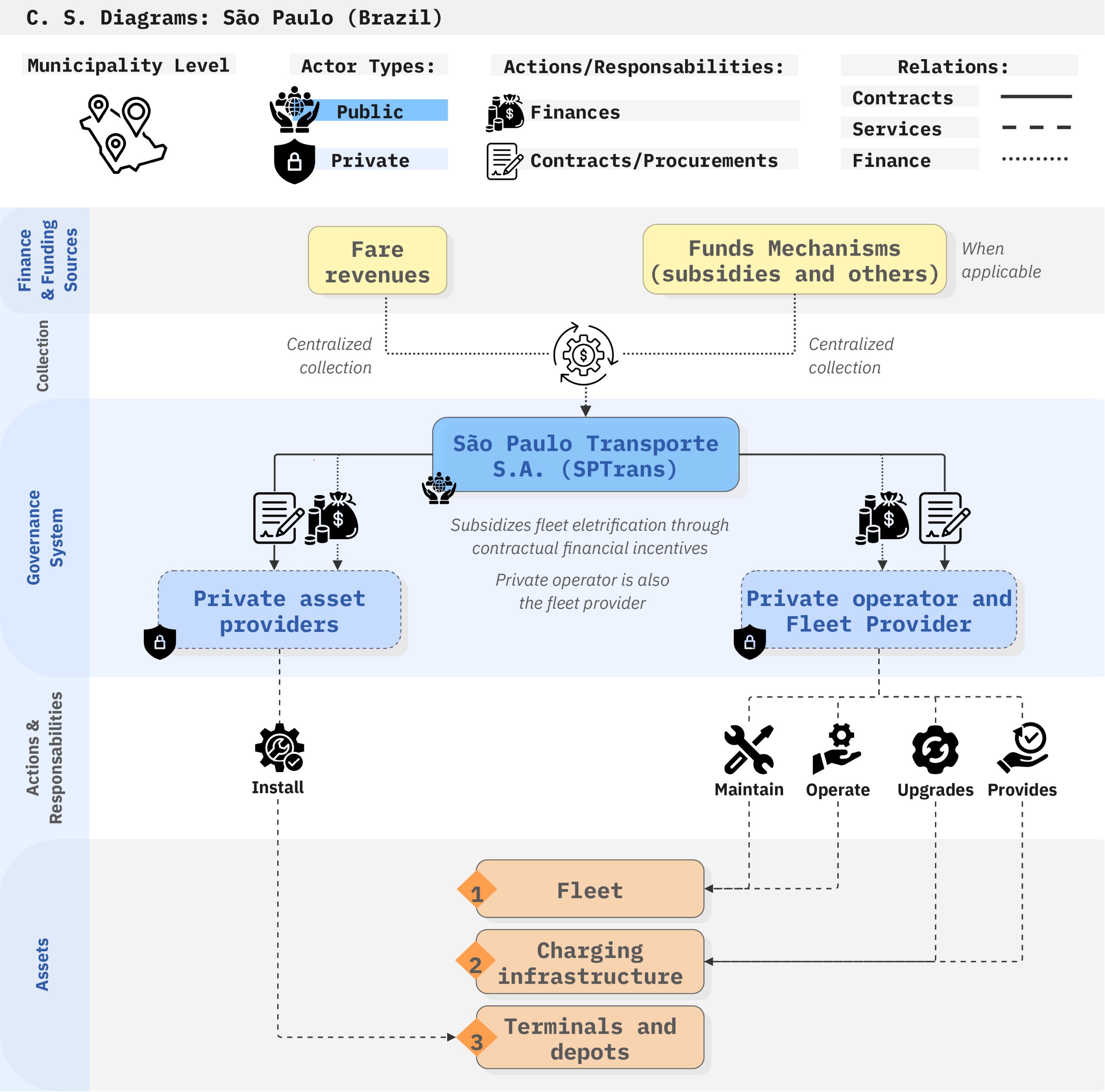
The São Paulo case is characterized by a business model in which fleet ownership and service operation are private, while the public authority, through SPTrans, plays a strong regulatory and coordinating role. SPTrans does not acquire buses and does not directly conduct procurement processes. Instead, it defines technical and operational requirements and verifies compliance with national and local technical standards, which guide specifications for electric buses.
Fleet electrification is enabled through a subsidy model, under which the public sector covers the difference between the cost of an electric bus and a conventional diesel vehicle. This subsidy is facilitated through existing legislation, meaning that formal procurement processes are not required, and the government can directly finance electric vehicles within the system. For this reason, the São Paulo case was not included in the database because the procurement documents are unavailable. However, it represents a rapidly evolving model, with the electric fleet expanding at a fast pace.
In terms of regulatory and institutional enablers, current concession contracts include explicit requirements for compliance with decarbonization targets, while allowing flexibility in technology choice. Although battery-electric buses currently represent the most advanced option, contracts also allow for other low- or zero-emission technologies, such as hydrogen or renewable fuels. This contractual flexibility is supported by strengthened institutional capacity, developed through technical cooperation agreements with research institutions and international organizations, which have enabled knowledge transfer, pilot testing, and the development of a model tailored to São Paulo’s local context.
Key takeaways
The São Paulo case illustrates how large-scale bus electrification can be driven by strong public regulation and financial support, even in models where fleet ownership and operation remain fully private. Clear technical standards and a subsidy-based financing model have enabled the gradual introduction of electric buses while maintaining flexibility for operators. This local framework is also reinforced by broader climate-oriented initiatives, such as “Compromisso SP Carbono Zero,” which encourage organizations to work toward carbon neutrality and further support the adoption of measures such as bus fleet electrification.
At the same time, the case provides an important lesson on implementing turnkey delivery models. In São Paulo, the public subsidy—operationalized through São Paulo Transporte S/A—is paid directly to the manufacturer, but only once the full system is operational. This includes not only vehicle delivery, but also the completion of charging infrastructure and grid connection, ensuring that buses are ready for immediate operation.
While this approach aims to ensure performance and system readiness, in practice, it has created coordination challenges among multiple actors, including operators, manufacturers, infrastructure providers, and energy utilities. The requirement for full turnkey delivery before payment has exposed misalignments in timelines—particularly regarding depot electrification and grid upgrades—leading to delays and tensions among stakeholders.
More broadly, São Paulo demonstrates that electrification is constrained not only by vehicle procurement or financing mechanisms but also by infrastructure and energy-system readiness. The need to upgrade depots from medium- to high-voltage connections is a major bottleneck, especially in dense urban environments where infrastructure works are complex, costly, and time-consuming.
As a result, São Paulo’s experience reinforces the importance of long-term planning, institutional coordination, and close alignment between transport authorities and the energy sector when scaling electric bus deployment in large systems.
References
This case study was developed based on discussions with representatives of the local authority (SPTrans). The analysis also draws on the review of relevant technical reports, as outlined in the project documentation.