E-Bus Procurement Observatory
Select a city:
Belém, BR
City context
Belém is a major urban center in northern Brazil and the capital of the state of Pará. Public transport in the city is predominantly bus-based and plays an important role in urban mobility. Recent efforts to modernize the system have been closely associated with the implementation of a metropolitan BRT system, designed to improve metropolitan integration and service quality through a more efficient operation and dedicated corridors.
In this context, the introduction of electric buses in Belém has been linked to these initiatives, with a large share of the electric fleet operating within the BRT system. According to the E-Bus Radar (Feb 2026), the city currently has a fleet of 45 electric buses. This positions Belém as an example of an early-stage electrification initiative in which electric buses are introduced as part of a wider transformation of the public transportation system rather than as a standalone measure. The BRT system itself comprises approximately 17 km of dedicated infrastructure and is being implemented as a metropolitan system, integrating multiple municipalities in the Belém Metropolitan Region.
The review of procurement documents in Belém identified two procurement processes: one for fleet purchase (2023) and one for service operation (2025). Together, these processes account for 265 new electric vehicles to be operated in the future, all of which are provided through the fleet purchase process.
Governance, Business, and Financial Model
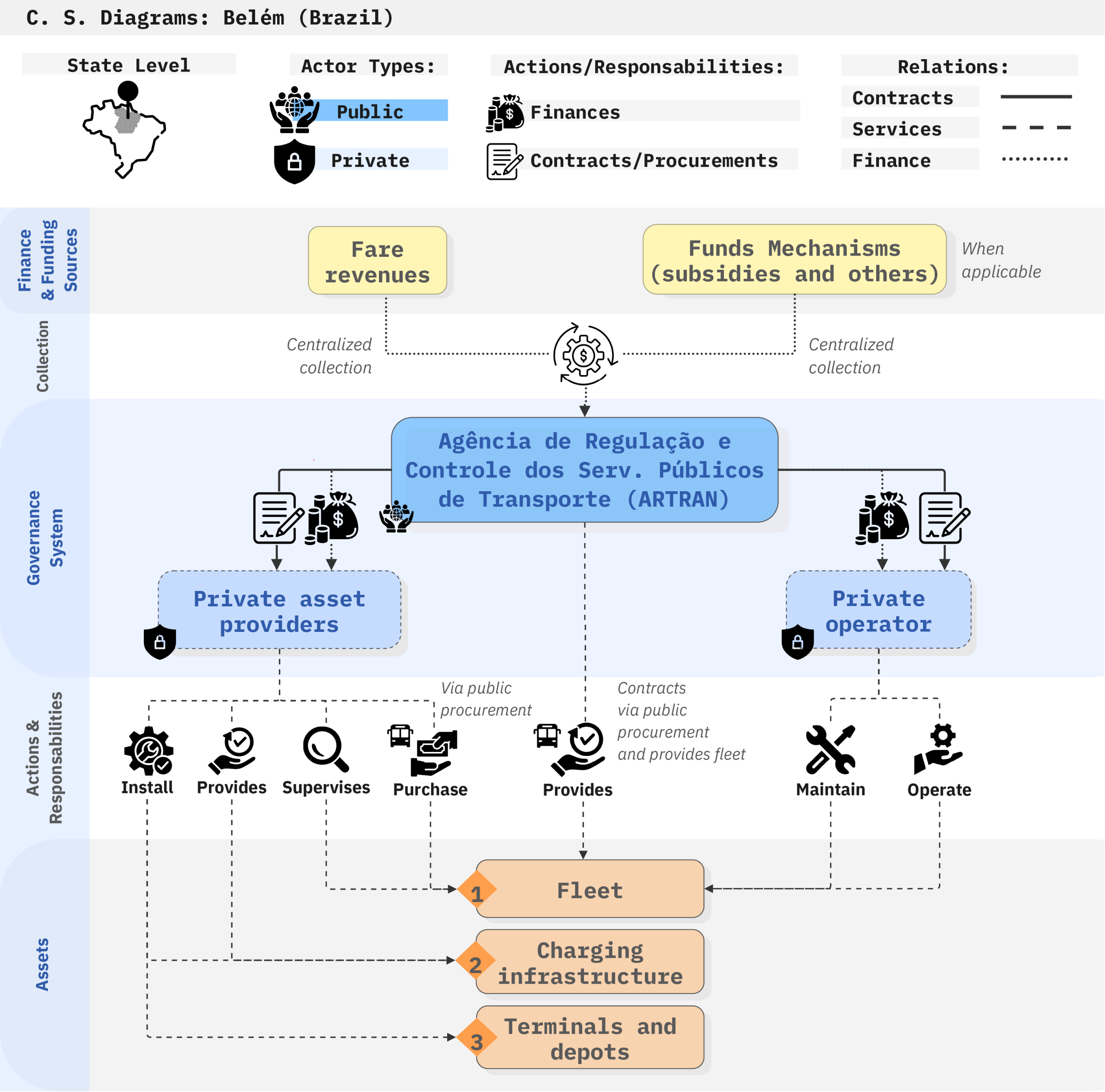
The Belém case follows a public-fleet acquisition-and-private-operation model. Electric buses are procured through public procurement processes led by the state-level public authority (the Government of Pará), while service operations are carried out by private operators under concession agreements.
Under this arrangement, the public sector assumes responsibility for vehicle acquisition and technology selection, while private companies focus on service provision. In contrast to São José dos Campos, the Belém case involves the direct acquisition of vehicles by the public sector rather than leasing arrangements. This model allows the municipality to introduce electric buses directly into the system. However, it also concentrates the financial risks associated with fleet acquisition on the public side. Given the limited availability of complementary information beyond the procurement documents, the model likely reflects a more traditional contractual structure, with little information on financial and institutional innovations.
The operational model is structured around three separate concessionaires responsible for bus operations, electronic ticketing, and terminal/station management, each remunerated through distinct tariffs based on service outputs. Fare revenues are centrally collected and redistributed by the public authority. To ensure financial stability, a fare-compensation fund was established to balance fluctuations between fare revenues and system costs. In addition, fleet acquisition, particularly for electric buses, has been strongly supported by federal financing, which covered a large share of investment costs, reducing the immediate fiscal burden on the state government.
Key takeaways
The Belém case highlights both the opportunities and the practical constraints of introducing electric buses through conventional procurement processes alongside broader public transport modernization initiatives, such as the implementation of new BRT corridors. On the one hand, it illustrates how existing modernization projects can serve as pathways for fleet electrification. On the other hand, while public acquisition of vehicles can enable initial efforts, experiences from other cases indicate that scaling electrification over time may require complementary and more sophisticated financial mechanisms to support long-term service sustainability. These may include, for example, fleet leasing or other arrangements that reduce upfront costs for the public sector.
Overall, the case illustrates that electrification efforts introduced alongside system modernization initiatives often rely on relatively straightforward governance and business arrangements, and that such experiences are transferable to other similar urban contexts. While such models can support early deployment, long-term sustainability and scalability depend on gradual institutional learning and access to long-lasting financial mechanisms.
References: This case study was developed based on the review and interpretation of publicly available procurement documents, as presented in the database (id: 401 and 402), as well as discussions with representatives of the local authority. The analysis also draws on the review of relevant institutional and technical reports, as outlined in the project documentation.