Guide for the co-financing of electric buses under article 172 of the national development plan
This guide, developed by the ZEBRA Alliance in collaboration with the National Government of Colombia, details the technical, financial, legal, institutional, social, and sustainability requirements that local territorial entities must meet to access co-financing for public transport systems with electric bus fleets, under Article 172 of the National Development Plan 2022-2026 and Resolution 20243040018695. The document describes in a structured manner the mandatory steps and components for project submission, such as establishing a public management company, conducting feasibility studies (transport, operational, financial, and remuneration models), creating an implementation and infrastructure plan, outlining sustainability strategies and measures to mitigate illegality, and designing the Fare Stabilization Fund. Finally, it guides local actors on commitments regarding cadastral updates, land value capture, modal integration, and the 21-stage administrative procedure required before ministries and the DNP to sign the co-financing agreement.
Related Publications
-
Financing e-buses in São Paulo: the partial subvention model
-
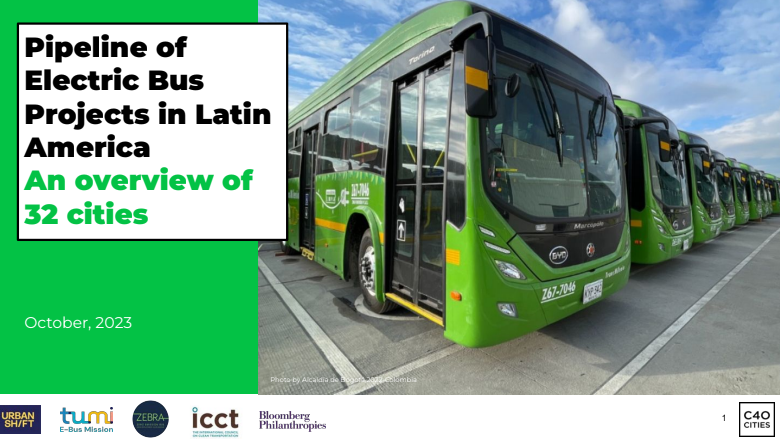
Pipeline of Electric Bus Projects in Latin America: An overview of 32 cities
-
Electric bus pilots in the public transportation system of the city of Medellín
-
Generation of technical and financial information from the development of electric bus pilot tests in intermediate cities of Colombia
-
Charging infrastructure for battery electric bus operations: evidence from the city of São Paulo